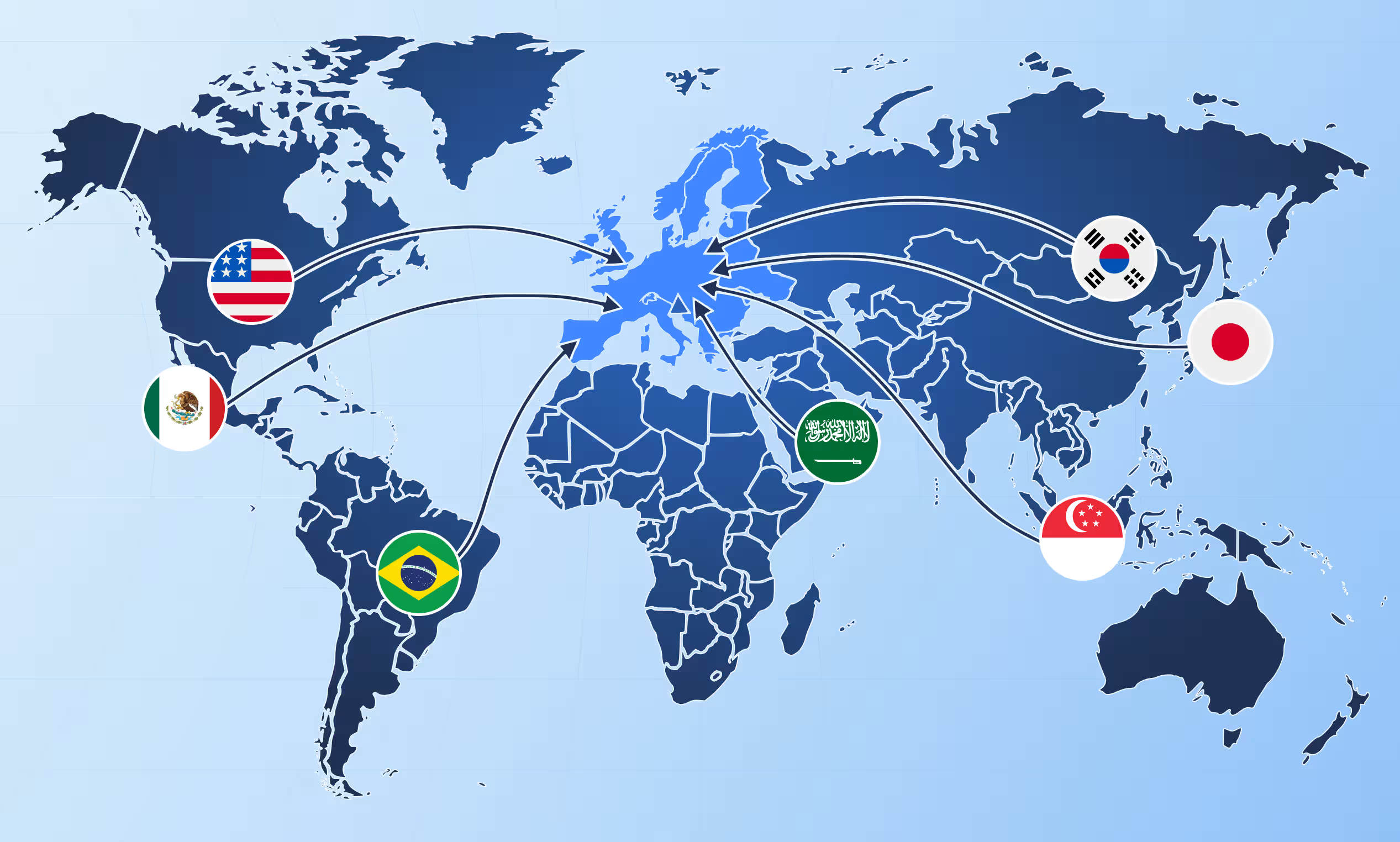
Expanding into Europe is one of the most appealing prospects for US and UK businesses looking to grow beyond their home markets. The European continent boasts a large and relatively wealthy consumer base, extensive industrial supply chains, a broad rule-of-law environment, and advanced digital infrastructure.
However, the opportunity is far from simple: language diversity, regulatory complexity, variations in personnel costs and employment law, and the requirement for localised marketing need that businesses approach the region with both ambition and accuracy.
This guide will walk you through all you need to know about conducting business in Europe, including target markets, legal/regulatory frameworks, recruiting people, joining e-commerce, setting up digital marketing, and working with strategic partners.
Whether you are a US software company seeking an EU launch or a UK goods company exploring business opportunities in continental Europe, this guide provides a structured roadmap to assist you in navigating the landscape. The goal is to make your European expansion less chance-based and more about planning, understanding, and execution.
Why Europe Matters for US and UK Companies
Market Size and Growth Potential
Europe's combined economic magnitude makes it an extremely desirable market for expansion. For example, Eurostat data show that in 2024, the average hourly labour cost in the European Union was €33.5, which is a useful indicator of the region's mature incomes and purchasing power.
European Commission
According to data from the European Free Trade Association and other sources, the enterprise-birth rate (number of new companies per active enterprise) in member states was 10.7% in 2021.
The European Free Trade Association (EFTA)
From the standpoint of a US/UK corporation, this means that Europe provides not only traditional markets such as Germany, France, the United Kingdom, and the Netherlands, but also dynamic newer markets such as Eastern and Central Europe, which are becoming more integrated.
Strategic Advantages
Some strategic benefits for the United States and United Kingdom firms include:
- Access to a broad, generally rich consumer base: Your firm being able to connect with a wide customer base that is spread over numerous nations, allowing for economies of scale.
- The European single market: Having access to the EU single market permits goods and services to cross borders relatively easily (subject to compliance).
- A reputation boost: doing business in Europe might help you gain international credibility for your global presence.
- Supply chain and logistical benefits: Europe has world-class infrastructure, transportation connectivity, port/hub access, and a digital backbone.
- Talent availability: Many countries have highly skilled labor, multilingual workforces, and favorable conditions for knowledge-intensive enterprises.
In short, establishing the groundwork in Europe may act as both a growth engine and a strategic base for larger worldwide operations.
Economic Landscape & Growth Trends

GDP and Business-Demographics Overview
The collective economy of Europe (especially the EU) remains one of the world's largest. According to sources, EU financial assets exceed US$41.9 trillion, with the euro (when used) remaining the world's second most traded reserve currency.
According to enterprise statistics, SMEs are dominant. In Europe, 99% of enterprises are small and medium-sized businesses.
For a US/UK entrant, this means both possibilities and competition: you will frequently be dealing with dynamic local enterprises as well as global competitors.
Emerging Growth Regions in Europe
While Western Europe remains mature, Central and Eastern Europe offer expansion opportunities. Lower labor costs, improved infrastructure, and proximity to supply chains make countries such as Poland, Czechia, Hungary, Romania, and the Baltics appealing.
Poland, for example, is the EU's sixth-largest economy in terms of nominal GDP and a rapidly growing market.
Growth in these regions may be higher than the Western norm, allowing US/UK corporations to establish a footprint early. At the same time, one must weigh growth potential against execution risk (e.g., regulatory, language, and logistical complexity).
Legal and Regulatory Frameworks
Regulatory Environment Across Europe
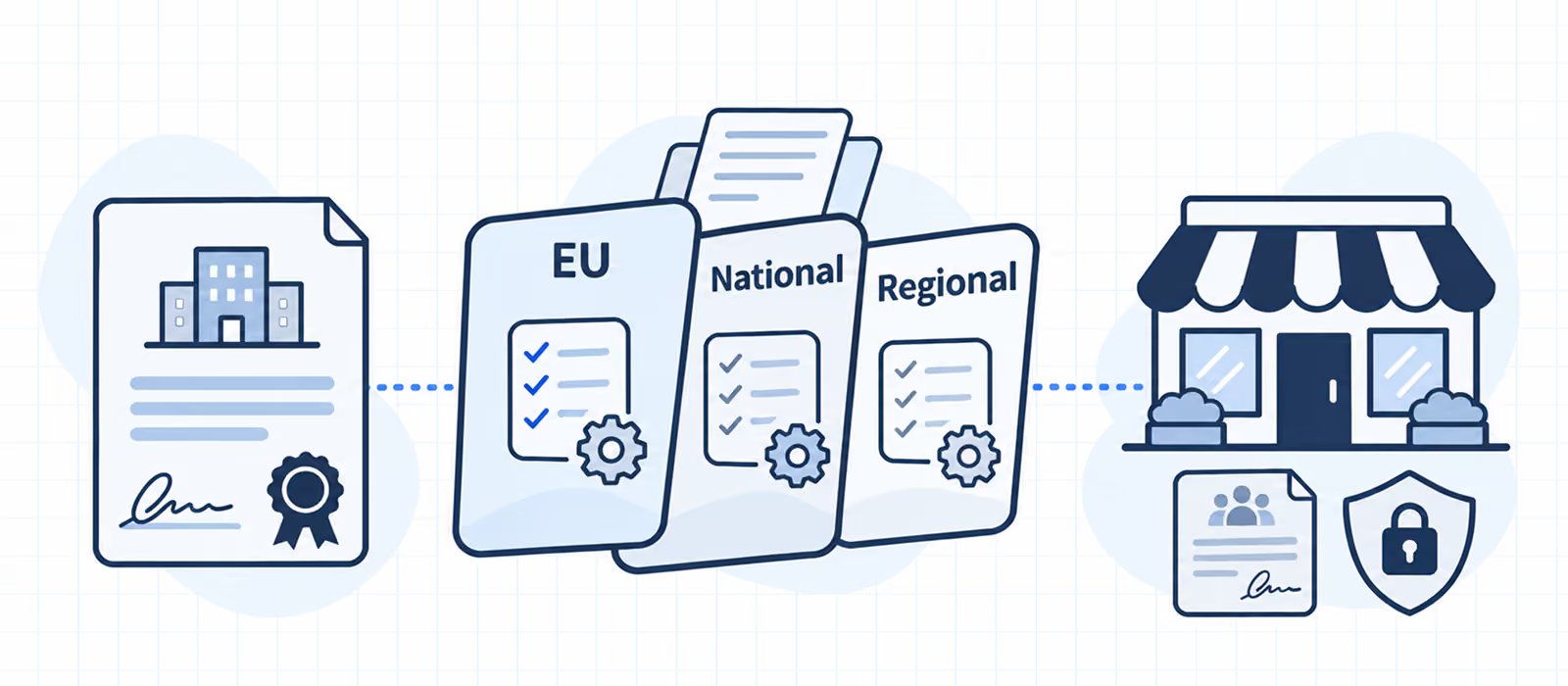
Regulation in Europe is more complex than in many US states or the UK, owing to multi-layer governance (EU, national, and regional). According to the World Bank's historical "Ease of Doing Business" rating, Europe and Central Asia scored around 71.8 (out of 100) in 2019, while the OECD high-income group scored 78.2.
Though the World Bank discontinued the Doing Business report in 2021, new frameworks like "Business Ready" aim to quantify regulatory readiness.
For a US/UK company, this means that thorough legal planning is required: comprehending company law, registration procedures, tax compliance, employment legislation, data protection (e.g., GDPR), and cross-border trade restrictions is not optional.
Starting and Running a Business: Ease & Bureaucracy
The World Bank defines ease of doing business as founding a business, trading across borders, paying taxes, and enforcing contracts.
Europe performs pretty well when compared to global rivals, but differences in business cultures matter, such as shorter start-up timeframes and fewer formalities in Estonia and Hungary compared to others.
A US/UK firm must consider time-to-launch, local incorporation procedures, and whether to operate through a branch, subsidiary, or distribution partner.
Employment Law & Compliance
Employment law in Europe typically includes more worker protections, more formal termination procedures, and stricter benefit requirements than in many US states. This influences how a US/UK firm handles recruitment, contracts, payroll, benefits, and terminations.
Furthermore, cross-border services may result in local establishment regulations, collective bargaining responsibilities, and data privacy obligations. Early legal advice is strongly advised to avoid fines or forced restructuring later.
Labour Costs, Recruitment, and Employer Overheads

Labour Cost Levels and Structure
According to EU labour cost data, the average hourly labour cost in 2024 was €33.5, with non-wage costs (employer social payments, for example) accounting for 24.7% of total labour costs. (From €10.6 in Bulgaria to €55.2 in Luxembourg).
Thus, the structure comprises wages, employer social contributions, training, and other overheads. For US/UK businesses, evaluating labor costs across European countries is an important aspect of the site selection decision: the difference between €10 and €50+ per hour is significant.
Recruitment Considerations and Indirect Costs
When recruiting employees in Europe, beyond wages, you must account for: employer social contributions, mandated benefits (holiday, pension contributions, sick leave), local payroll services, potentially higher indirect recruitment costs, onboarding in a multilingual environment, and termination or severance obligations.
Moreover, cross-border recruitment (for example, forwarding staff from the US/UK) may trigger local permanent establishment risk, tax withholding, and social security obligations.
A practical recommendation: budget for employer-cost multipliers (wage x 1.25–1.4 in many Western European markets) and check local HR compliance.
Cross-Border Employment Issues
If you intend to hire employees in Europe (rather than simply sell remotely), you must examine local labor law, social security registration, local tax withholding, and the possibility of establishing a local corporation or working with an employer-of-record. Differences in working hours, holiday entitlements, and union relations must also be considered.
For example, recruiting in Germany, France, and Spain will result in varying regulatory difficulties. Working with a regional HR or PEO provider early on can help a US/UK business avoid risk while evaluating local market fit.
Technology Adoption, Innovation, & Digital Infrastructure

Digital Readiness of European Markets
Most European countries are well-digitised: Western Europe has excellent e-commerce, mobile payment, internet penetration, and digital consumer habits, while Central and Eastern Europe are fast improving.
For a US/UK company that provides a digital service or product, this signifies that the infrastructure is generally present.
The crucial question is how your product is localized (language, regulatory compliance, data localization) and whether you can collaborate with local digital platforms. Europe's push for digital transformation (for example, e-government services) is gaining traction, which bodes well for technology-enabled businesses.
Innovation Ecosystems and Venture Capital
Europe has a dynamic, but somewhat smaller, risk-finance ecosystem than the United States. According to wide projections, European venture capital investment will reach €12.9 billion in 2023, spread over nearly 4,800 enterprises.
Furthermore, the European startup ecosystems in locations like Berlin, Amsterdam, Stockholm, and Lisbon are robust. For US/UK enterprises seeking innovation alliances, acquisition targets, or local R&D links, Europe provides credible options. Nevertheless, deal sizes may be smaller and exit paths lengthier than in the US.
Analysing Business Cultures

Language Complexity vs. English-Speaking Ability
Language diversity is an often-overlooked obstacle in European expansion. Unlike the United States, where one language prevails, Europe has dozens of native languages. However, many European professionals speak English, especially in northern and central markets.
The challenge for US/UK businesses is to evaluate whether your product/service needs to be localized (website translation, customer care in the local language) and whether your sales/marketing team needs to interact locally.
English is widely spoken in many European countries (for example, the Netherlands, Sweden, and Germany). However, clients/customers prefer to communicate in their own tongue when there is a high value involved.
Cultural and Consumer Behaviour Variation
Cultural differences influence company models, marketing strategies, negotiating tactics, partnership structures, and consumer expectations.
For example, purchasing behaviour in Spain may differ greatly from that in Finland. Another consideration is that payment mechanisms may differ (for example, iDEAL in the Netherlands and SEPA direct debit in Germany). Furthermore, business contracts may use distinct negotiation approaches.
US/UK enterprises should invest in local market research, ideally through local partners or consultants, to avoid the misconception that "Europe is one market." The phrase "Europe is many markets" remains true, and corporations that flatten their approach risk misaligning product, pricing, or messaging.
Country Selection: Which European Markets Are Best?
Top Western Economies
Germany, France, the Netherlands, Sweden, and Ireland have consistently high rankings for business climate, infrastructure, and purchasing power. Western European countries, for example, are known for having high median hourly incomes (€19+ in Denmark in 2022) and robust consumer markets.
These are frequently the first ports of call for US/UK corporations moving into Europe, but they come with higher labor costs, more competitive landscapes, and occasionally stricter regulations.
High-Growth Eastern & Central European Markets
Different markets such as Poland, the Czech Republic, Hungary, Romania, and Bulgaria may offer advantages to enterprises looking for greater expansion opportunities and potentially cheaper cost bases. Poland, for example, has experienced rapid expansion and increased prominence.
While growth is strong, difficulties include lower local consumer spending, worse infrastructure in some areas, and perhaps more complex local regulatory or enforcement frameworks.
Key Ranking Metrics and What to Watch For
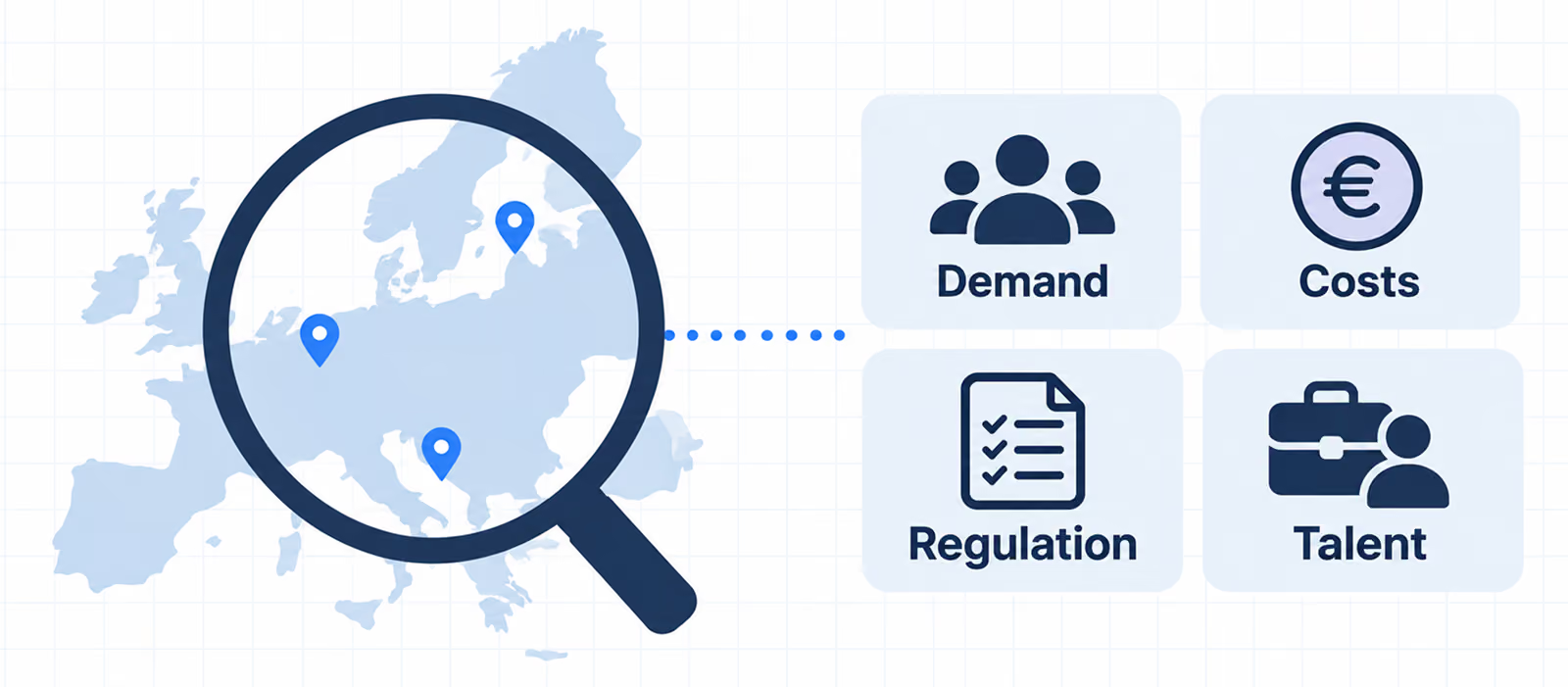
When selecting a nation, US/UK companies should consider:
- Labor costs and structure
- Ease of company formation and local regulatory burden
- Logistics, transportation, and fulfillment capabilities
- Digital readiness and e-commerce maturity
- Language/English competency and local partner availability
- Taxation system (corporate tax, VAT, withholding tax, tax treaties)
- Access to talent (linguistic and digital skills)
- Market size and growth forecast
- Competitor and partner ecosystem
While rankings such as the World Bank's "Business Ready" index are still being released, they show that Hungary and Estonia rank highly for regulatory frameworks. It should be noted that US/UK enterprises should employ both quantitative measures and qualitative local insight.
E-commerce Expansion in Europe
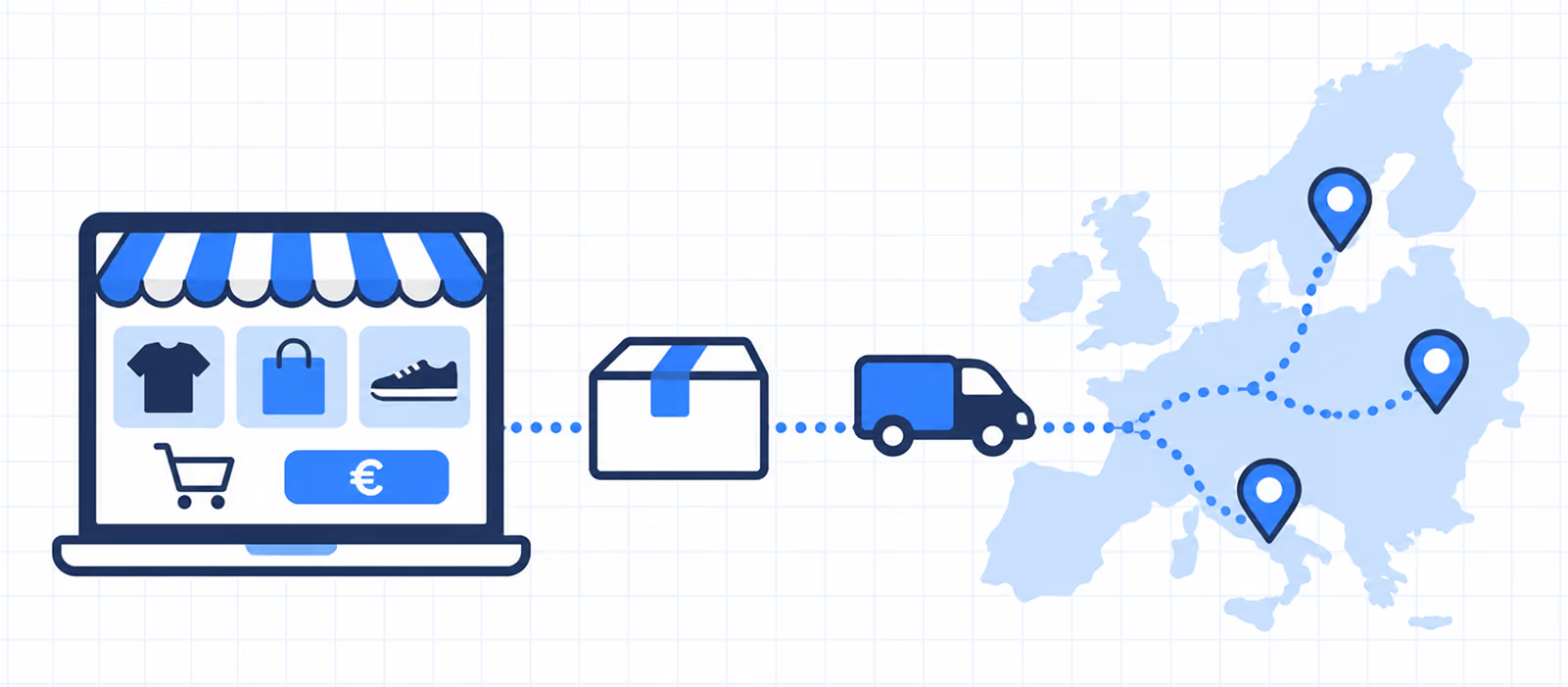
Why E-Commerce Matters in Europe
For many US/UK businesses, entering Europe through e-commerce, or as a supplement to physical presence, is a cost-effective and scalable option.
European customers are becoming more comfortable purchasing online across borders, and digital platforms enable quick market entry. Combining e-commerce with local logistics and marketing can significantly increase your presence.
Localisation, Fulfilment, and Logistics
Key considerations include translating your site or app, adjusting pricing to local currencies (€, £, etc.), taking care of local taxes and duties (especially VAT), offering local payment methods (cards, direct debits, e-wallets popular in specific countries), and optimizing fulfilment logistics (warehousing, returns, last-mile, cross-border shipping).
Partnering with local logistics companies or pan-European fulfilment networks is frequently recommended. Europe's landscape is more fractured than the United States', making logistical planning more difficult.
Payment Methods, Cross-Border VAT, & Regulation
VAT (value-added tax) is an important factor to consider: based on your turnover and sales model, you may need to register for VAT in each country. The European Union implemented the One-Stop Shop (OSS) system to ease cross-border VAT on goods and services, but compliance remains challenging.
Payment methods differ: for example, Dutch consumers frequently utilize iDEAL, but Germans use "Sofort" and direct debit. Offering local, familiar payment choices is critical to conversion rates.
On the regulatory front, digital consumer protection legislation, data privacy (GDPR), and local product safety compliance must all be addressed.
Preparing Your Marketing & Digital Presence for International Expansion

International SEO & PPC strategy
When targeting Europe, your digital marketing approach must be multilingual, cross-regional, and multichannel. Think about partnering with an agency that can help deliver your International SEO plans. The earlier you various regional sites start being visible in the local search and AI engines, the better for your business.
It will take some time to reach organic and AI search visibility in international markets, so you may want to invest some of your international campaign budget in paid visibility so that leads begin pouring in. International PPC and paid advertising will help with reach out to specific audiences based on geography and language.
Localizing meta-titles, H1 tags, URL structures (ccTLDs or subfolders), geographic targeting, and local link-building and AI Search tactics are all essential for success.
Brand Positioning and Localisation
Your brand and messaging may need to be adjusted for each market, as what works in the United States may not be effective in Germany or Spain.
Colours, symbolism, consumer values, and trust signals differ. Localizing your content (rather than simply translating it) is essential: consider local testimonials, case studies, local currency costs, local delivery alternatives, and country-specific deals.
Furthermore, social media preferences vary: Instagram and TikTok may be popular in one market, while LinkedIn, Twitter, or local platforms may be dominant in another.
Multi-Channel Digital & Offline Activations
Many European markets require an offline presence in addition to digital marketing, such as trade exhibitions, local alliances, influencers, events, and local public relations. The combination of online and offline channels boosts brand confidence and promotes adoption.
Consider local retailer partnerships (for goods), pop-ups, localized webinars, localized customer-support capabilities, and culturally conscious ads (for example, local holidays and consumer habits).
Planning your marketing plan well in advance of launch will shorten time-to-market and prevent initial misalignment.
Partnerships: The Critical Leverage Point

Why Partnerships Matter in European Expansion
Expanding into Europe is sometimes more challenging than domestic expansion because language, regulation, logistics, payment, and local marketing must all be considered.
Strategic collaboration enables many businesses to reduce risk, expedite time-to-market, and exploit local expertise. For example, for logistics and cross-border supply chain, you may collaborate with a specialist like Ewals Cargo Care (or equivalent), which works throughout Europe.
Working with a global marketing firm with a strong European base, such as Digitalico, may provide deep regional know-how, local network access, and localization skills. These collaborations allow you to focus on your main product or service while the partner handles regional execution.
Types of Partners (Logistics, Marketing, Local Expertise)
- Logistics partners: They assist with fulfilment, warehousing, shipping, customs, refunds, and delivery in different European countries.
- Marketing and brand-building partners: They know the local language, digital behavior, media outlets, influencer ecosystems, and regulations.
- Local distribution or sales partners: They understand local B2B or B2C channels, retail networks, regional customs, and reseller networks.
- Local legal and compliance partners: They are vital for navigating employment law, taxation, data privacy, product safety, and certification.
- Technology/localisation partners: They assist with software adaptation, user interface design, payment integration, and user experience localisation.
How to Evaluate and Structure Partnerships
When choosing a partner, consider their track record in your target country or region, multilingual capabilities, infrastructure they offer, cultural fit, alignment with your KPIs (growth, margin, speed), and contract clarity (scope, termination, exclusivity, liability).
The partnership agreement should be structured to include roles, responsibilities, deliverables, KPIs, reporting, confidentiality, data protection, intellectual property, termination, and an exit strategy.
Importantly, ensure that the partner does not create an unnecessary local permanent-establishment risk for your organization. Determine who acts as principal versus agent. For US/UK enterprises, this cooperation layer frequently makes the difference between a sluggish, expensive rollout and a smooth regional launch with local credibility.
Risks and Challenges to Navigate
Regulatory, Political, and Economic Headwinds
Although Europe has numerous advantages, there are risks: regulatory complexity (e.g., cross-border trade, VAT, data protection), political volatility (changes in government policy), macroeconomic headwinds (slower growth, rising energy costs), and regional divergence.
For example, foreign direct investment in Europe decreased in 2024 to its lowest level in nine years. Companies in the United States and the United Kingdom must plan for buffers and scenarios to account for the potential of slower-than-expected acceptance or regulatory delays.
Currency, Tax, and Transfer-Pricing Issues
Operating in different European jurisdictions exposes you to currency fluctuations (€, £, CHF, etc.), cross-border taxation, withholding tax, transfer pricing difficulties, permanent establishment risk, and various VAT regimes.
Preparing for tax and treasury functions is critical. Depending on your scale and product kind, you may want to use a decentralized structure (local entities) or a centralized center. Also, keep an eye on EU tax-harmonisation plans and changes to the taxation of digital services.
Operational and Logistical Complexities
Because of Europe's geographical and legal diversity, growing operations may necessitate the use of several fulfilment centres, customs cooperation, local returns handling, and adaptation to local delivery expectations.
Unlike US domestic logistics, which is largely uniform, European logistics frequently combines national legislation, languages, trucking regulations, and postal systems.
Data residency, privacy, and localization may add complexity to the operations of service providers. Hiring and managing employees in many jurisdictions complicates matters even more.
Action Checklist for US/UK Firms
The following is an action checklist that US/UK businesses can use to ensure that they are prepared to expand and do business in Europe. The checklist goes as follows:
- Define target markets in Europe: Organize by size, growth, digital readiness, and language.
- Conduct market research: Learn about consumer behaviour, payment preferences, local competition, and price.
- Budget for local labor and overhead costs: Ensure you do so based on hourly labor cost benchmarks (e.g., €33.5 for the EU average) and indirect employer costs.
- Select an entrance model: Direct sales, e-commerce, distribution partner, local subsidiary, or branch.
- Localize your product/service: By translating it, localizing the user experience, providing local language assistance, and accepting local payment methods.
- Create a digital marketing strategy for Europe: Make sure you’re leveraging international SEO and PPC platforms.
- Select and negotiate relationships with partners: Communicate with logistics/fulfillment companies, local marketing agencies, and legal/compliance advisors.
- Examine legal and regulatory requirements: Learn what you need for company incorporation, employment legislation, data protection (GDPR), and tax and VAT registration.
- Plan for logistics and fulfillment: Plan for warehousing, cross-border shipping, and returns management.
- Set up measurements and key performance indicators (KPIs): Prepare to observe your firm’s market entrance cost, time to break even, local marketing ROI, and partner performance.
- Keep track of risk factors: Be aware of legislative changes, currency fluctuations, economic downturns, and supply chain disruptions.
- Consider a phased approach: Start with a pilot market, learn from it, and then scale across additional European countries.
Conclusion
Doing business in Europe offers significant incentives for US and UK companies looking to expand beyond their main markets, but it is also quite complex.
The European market combines high consumer spending power, modern infrastructure, significant digital maturity, and room for expansion in emerging areas.
Language variety, regulatory complexity, varying labour-cost structures, and dispersed logistics all make success difficult to achieve.
The Essential Lesson
The key to a successful Europe strategy is strategic market selection, thorough planning for localisation (product, marketing, payments), strong partnerships (logistics, marketing, compliance), and a defined operational model.
Following the strategy outlined above, which includes estimating market size, employing people, implementing foreign SEO, and developing strategic relationships, will put you in a much better position to launch and scale a successful European expansion project.
Europe is not a single monolithic market, but rather a collection of interconnected markets with common laws and unique execution characteristics. Treat it like such, and it will become a powerful growth engine for your company.